cornerstone
The complete guide to surfing in Lisbon for first-timers
Everything a short-stay visitor needs to know to surf in Lisbon — beaches, seasons, costs, gear, transport, and what to expect on your first lesson.
By Lisbon Surf Weekend · Published April 26, 2026 · Updated April 26, 2026 · 16 min read
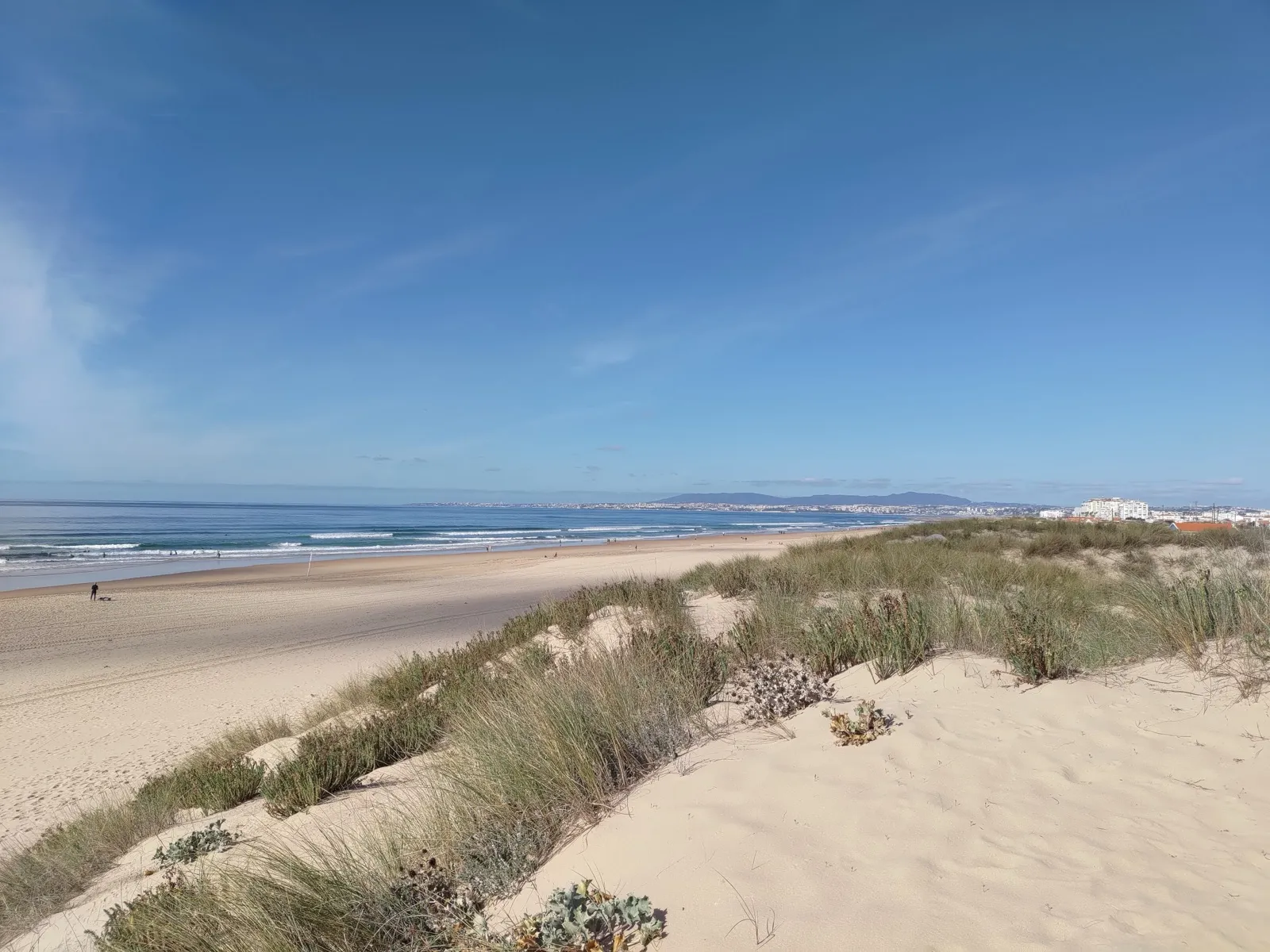
Short version: If you want to surf in Lisbon for the first time, it’s one of the best cities in Europe to do it. You can take a 25-minute train to Carcavelos or get picked up at your hotel and learn on a soft beginner board with a qualified coach. Surf is good year-round — winter actually has the best waves of the year, but they’re too big for a first lesson. As a beginner, aim for May–October when waves are friendlier and the water is warmer. Expect to pay €30–40 for a group lesson including all gear. Most beginners stand up within their first session.
Why Lisbon works for first-time surfers
Three reasons Lisbon is uniquely good for trying surfing on a short trip:
- Surf is genuinely close to the city. Most European capitals require a train ride, a car, or a flight to reach surfable waves. In Lisbon, you can be at Carcavelos beach 25 minutes after leaving Cais do Sodré station.
- The beaches are sandy-bottom beach breaks. No reef, no rocks, no urchins. Falling off your board lands you in soft sand. This matters more than any beginner thinks until they fall off.
- There’s a real surf school ecosystem. Dozens of operators with qualified instructors.
The beaches — which one to pick
There are three beaches a beginner visitor will choose between. Here’s the honest comparison.
| Beach | Distance from Lisbon | How to get there | Best for | Crowds |
|---|---|---|---|---|
| Costa da Caparica | 20–30 min | Car, taxi, or surf school pickup | All levels — especially good for beginners | Busy in season, spreads along the long beach |
| Carcavelos | 25 min | Train from Cais do Sodré | All levels | Busy year-round |
| Praia do Guincho | 45 min | Car only | Intermediate+ unless waves are very small | Busy and often windy |
Costa da Caparica
Our pick for beginners. A 26 km strip of soft sand on the south side of the Tagus, with mellow, forgiving waves and plenty of space to spread out — including dedicated school zones away from independent surfers. Get there by car, by surf school pickup, or by Uber/Bolt (~€15–22 each way from central Lisbon depending on bridge tolls and traffic). Our after-session ritual is an açaí at Surfin Coffee & Bowls before heading back to town.
Carcavelos
A wide, urban beach right next to the train station — a 5-minute walk from the platform to the surf schools. The downside as a learner: the wave is faster and hollower than Caparica, which makes for shorter, harder rides. It also gets very crowded in the water, and parking near the beach is essentially nonexistent.
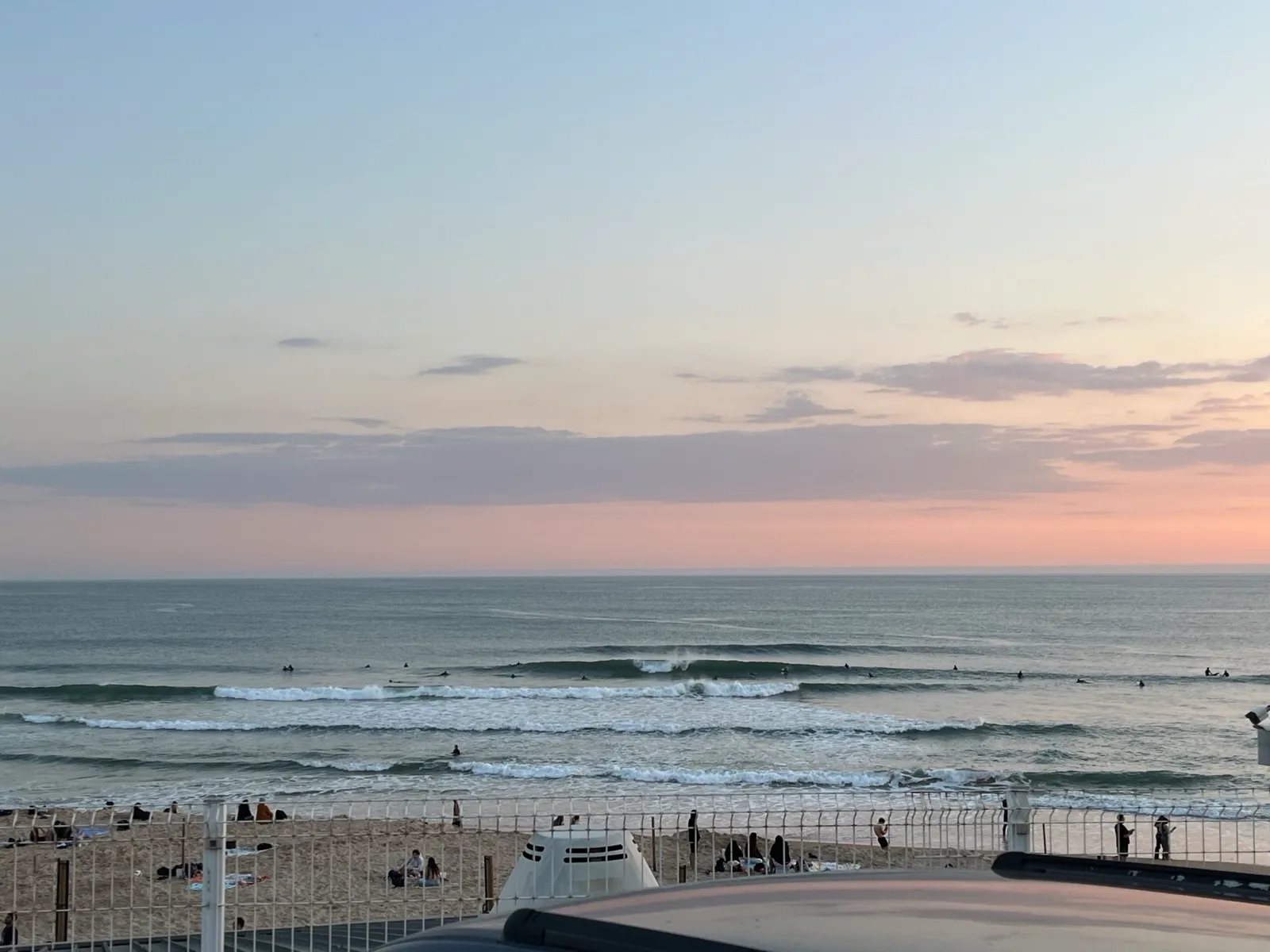
Carcavelos beach — easy to reach by train, busy year-round.
Praia do Guincho
Beautiful — but exposed to strong wind that frequently turns the surface into chop. Better suited to intermediate-and-up surfers, unless conditions are very small and clean. Also a popular kitesurf and windsurf spot.
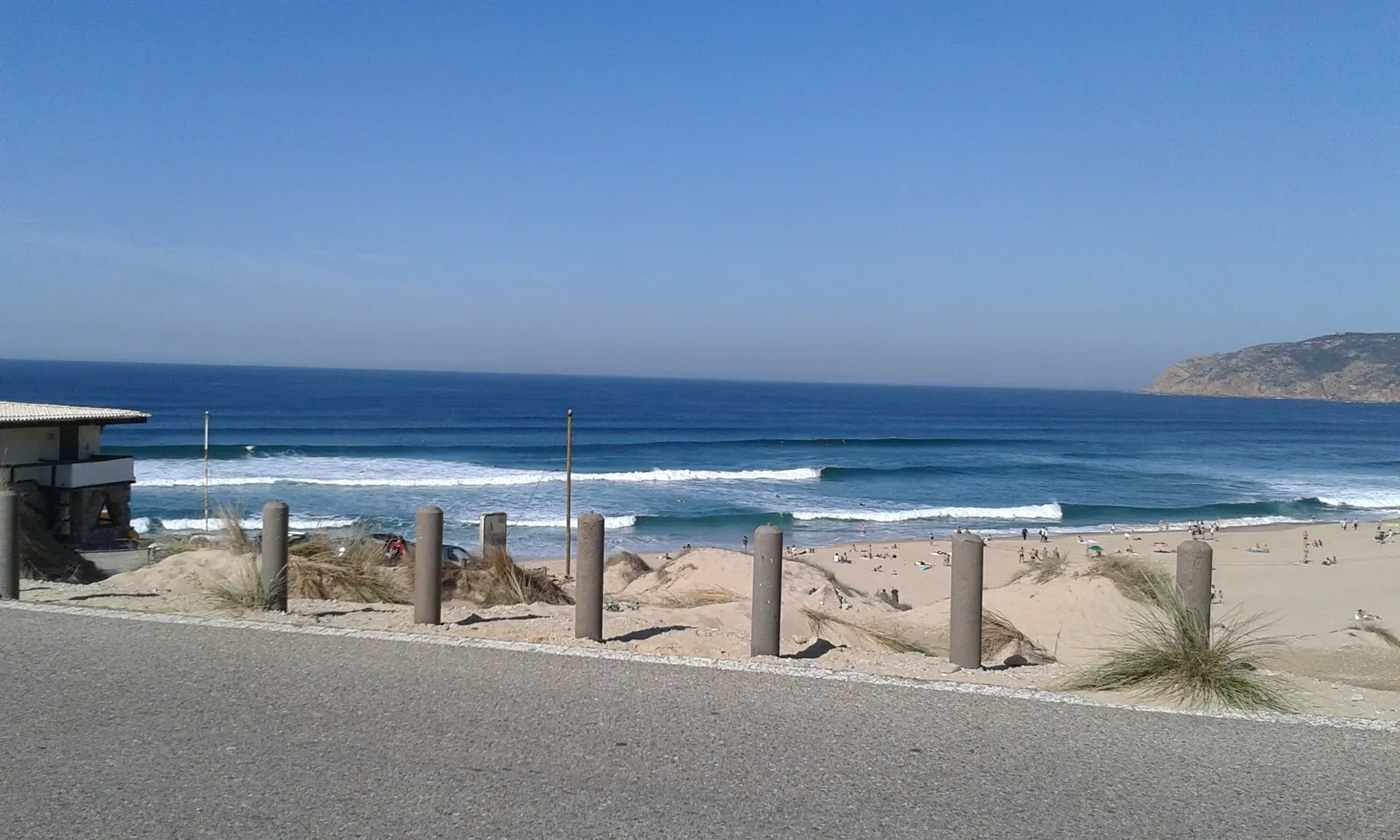
Praia do Guincho — dramatic and exposed, with the Sintra-Cascais headland on the right.
When to go — best months by experience level
Lisbon has surfable waves year-round. Winter actually delivers the best surf of the year — bigger, longer-period swells and cleaner conditions when wind cooperates. It’s why locals and experienced surfers love November through April. Those same conditions are simply more than a first-timer needs. The point isn’t that winter is bad — it’s that the lighter, friendlier days a beginner needs are far more common at other times.
| Season | Water temp | Wave size | Crowds | Beginner outlook |
|---|---|---|---|---|
| Beginner sweet spot (May, June, September, October) | 16–21°C | Small to medium, friendly | Building / dropping | The easiest window to plan around — small waves, warm water, fewer people in the lineup |
| Summer peak (July, August) | 19–21°C | Smallest of the year, often onshore by afternoon | Very high | Warm and easy, but packed — book early and aim for morning slots |
| Swell season (November through April) | 14–17°C | Bigger, more powerful, longer-period swells | Low | Beginner days exist, but they’re harder to find and more weather-dependent — rely on the school to pick the right beach and time |
Our take: the beginner sweet spot is May, June, September, and October. Water is warm enough to enjoy, waves are small enough to forgive mistakes, and the lineup isn’t packed shoulder-to-shoulder like in August. Winter is worth saving for your second or third trip — once you’ve got the basics down and want real swell.
What to expect on your first lesson
A typical group lesson with a Lisbon school looks like this:
- Meet at the school or pickup point (~9:00 or 14:00 for the two daily slots).
- Wetsuit and board fitting (10 minutes). You’ll get a thick foam soft-top — the easiest, safest board to learn on.
- Walk to the beach with the group (5–10 minutes).
- On-sand briefing (15–20 minutes). Safety, how to lie on the board, the pop-up technique, water etiquette.
- In the water (~90 minutes). The instructor stays with you in waist-deep water, pushes you into small whitewater waves, and coaches you to pop up.
- Walk back, change, debrief (15 minutes).
Total: about 2 hours from the moment you arrive.
Expect to stand up. Soft boards in small Lisbon whitewater are forgiving. Most first-timers in a 2-hour group lesson catch and stand on at least one wave. A few don’t — usually because of fitness or fear, not technique.
What to wear and bring
The school provides:
- Soft-top surfboard (sized to your weight)
- Wetsuit (3/2mm in summer, 4/3mm in shoulder season)
- Rashguard (sometimes)
You bring:
- Swimwear under your clothes (changing on the beach is easier this way)
- Towel
- Sunscreen — reef-safe if you can get it, ideally a stick for face and zinc for nose. The Atlantic sun reflects off the water and you’ll be in it for 90+ minutes.
- Water bottle — surfing is more cardio than people think
- Something warm for after — even in summer the wind picks up post-lesson and you’ll be tired and slightly wet
What to leave at the hotel:
- Anything valuable (no real lockers at most schools)
- Watch, jewelry, electronics
- Anything you can’t replace
How to get there
From central Lisbon to Carcavelos
Train from Cais do Sodré (green line metro stop). Direction: Cascais. Get off at Carcavelos. Journey: 25 minutes. Cost: ~€2.40 each way. Trains run every 20 minutes.
From the station, walk straight downhill toward the ocean — about 8 minutes to the beach and the surf school strip.
From central Lisbon to Costa da Caparica
Option 1: Car/taxi. Cross the 25 de Abril bridge, exit toward Caparica. 20–30 minutes depending on traffic. Uber/Bolt ~€18–25.
Option 2: Bus. TST bus 161 from Praça de Espanha. Takes ~45 minutes. Cheaper but slow.
Option 3: Surf school pickup. Most Caparica schools offer pickup from central Lisbon hotels for €5–15 surcharge. For a first-time visitor without a car, this is usually the right call.
From the airport
If you’re going straight from the airport: take a taxi or Uber to your accommodation first, then proceed as above. Going to the beach with luggage rarely works out well — most schools don’t have secure storage for bags.
What you actually pay
Group lesson, 2 hours, including board + wetsuit + instruction:
| Operator type | Typical price |
|---|---|
| Carcavelos / Caparica group lesson | €30–40 |
| Private 1-on-1 lesson | €70–120 |
| 5-lesson package | €75–120 |
On private and semi-private lessons: in our opinion, if you’re genuinely there to learn, a private lesson on day one is worth the extra cost. Semi-private (you and a friend sharing one coach) is a sweet spot — cheaper than fully private, but you still get most of the attention. The coach corrects technique in real time, gives you more waves per hour, and physically pushes you into the right ones — which, as a beginner, is genuinely the hardest part.
How to choose a surf school
A few signals that matter and a few that don’t.
Signals that matter:
- Instructor ratio — max 5 students per instructor for beginners. Some schools push to 8. Avoid those.
- Coach is active in the water — we strongly prefer schools where the instructor stays in the water with students, helping them catch waves and pointing out technique errors in real time. Avoid schools where the coach stands on the beach watching from the sand.
Common mistakes first-timers make
If we had to pick the most avoidable ones, these are the four:
- Eating a heavy breakfast. A 90-minute paddle on a full stomach is unpleasant. Light food, early.
- Wearing contact lenses. They will come out in the water. Bring glasses for after, or get used to seeing blurry for 2 hours.
- Trying to surf alone on day one. Renting a board and paddling out without a school usually means the wrong spot, the wrong conditions, the wrong board, and no one to help you read the water. A first lesson exists for a reason — get the basics with a coach, then explore on your own once you can spot a beginner-friendly day.
- Booking the afternoon slot in summer. Wind picks up by 14:00. Morning lessons are objectively better.
What’s next after your first lesson
If you loved it:
- Keep going while it’s fresh. Book a few more lessons soon — short gaps between sessions help the technique stick. After 4–5 lessons you’ll have the basics down, and on the right day (ask the school what conditions to look for) you can rent your own gear and start surfing without an instructor.
- We’d recommend a surf camp next time. A full week of surf with multiple sessions per day moves you forward much faster than scattered single lessons. Plenty of camps in Portugal cater to exactly this stage of learning — Booksurfcamps is a good place to compare options across Algarve, Ericeira, and Peniche.
If you didn’t:
- If standing up just isn’t for you, consider bodyboarding. You still ride the wave — just lying on your belly instead of standing. There are good bodyboard schools in Lisbon, and don’t write it off as a beginners-only thing: serious bodyboarders pull tubes, airs!
Frequently asked
- Can a complete beginner surf in Lisbon?
- Yes. There are several beginner-friendly spots near Lisbon — in our opinion Costa da Caparica is the best one, with mellow, forgiving waves over a long stretch of soft sand. Carcavelos also works and is the easiest to reach by train. Most beginners stand up on a foam board within their first 2-hour lesson.
- How far is the surf from central Lisbon?
- Carcavelos is about 25 minutes by train from central Lisbon. Costa da Caparica is roughly 20–30 minutes by car. Most surf schools include pickup from the city for a small surcharge.
- What is the best month to surf in Lisbon as a beginner?
- Lisbon has surf year-round, and winter delivers the best waves of the year — but those bigger, longer-period swells are too much for a first lesson. As a beginner, aim for May, June, September, or October: water is warmer, waves are friendlier, and the lineup is less crowded than peak August.
- How much does a surf lesson cost in Lisbon?
- Group lessons typically cost €30–40 for a 2-hour session including soft board, wetsuit, and instruction. Premium small-group lessons run €45–60, and private lessons range €70–120.
- What should I bring?
- Swimwear under your clothes, a towel, sunscreen (reef-safe ideally), water, and something warm for after. The school provides board, wetsuit, and rashguard.